Project · Fitted wardrobe · 2025
Four sheets, two modules: what a confirmation set is for
Not every job needs a production pack. Sometimes what you need is a clean, dimensioned set to get a customer to say yes — before anything is committed to manufacture.

The brief
A fitted wardrobe, two modules, MDF fronts on an MFC carcass. The client was not asking for production documentation. They needed something to put in front of their own customer to get sign-off — and they needed it quickly, because the customer was waiting and the job could not be priced or ordered until it was approved.
This is a common and often badly handled situation. The temptation is to send the customer either a glossy render that shows nothing useful, or a full production drawing set that overwhelms them. Neither gets you a clean approval.
What a confirmation set has to do
A confirmation set has exactly one job: make it impossible for the customer to approve something and then say afterwards that they thought it would be different. Every sheet in it exists to close off one category of that argument.
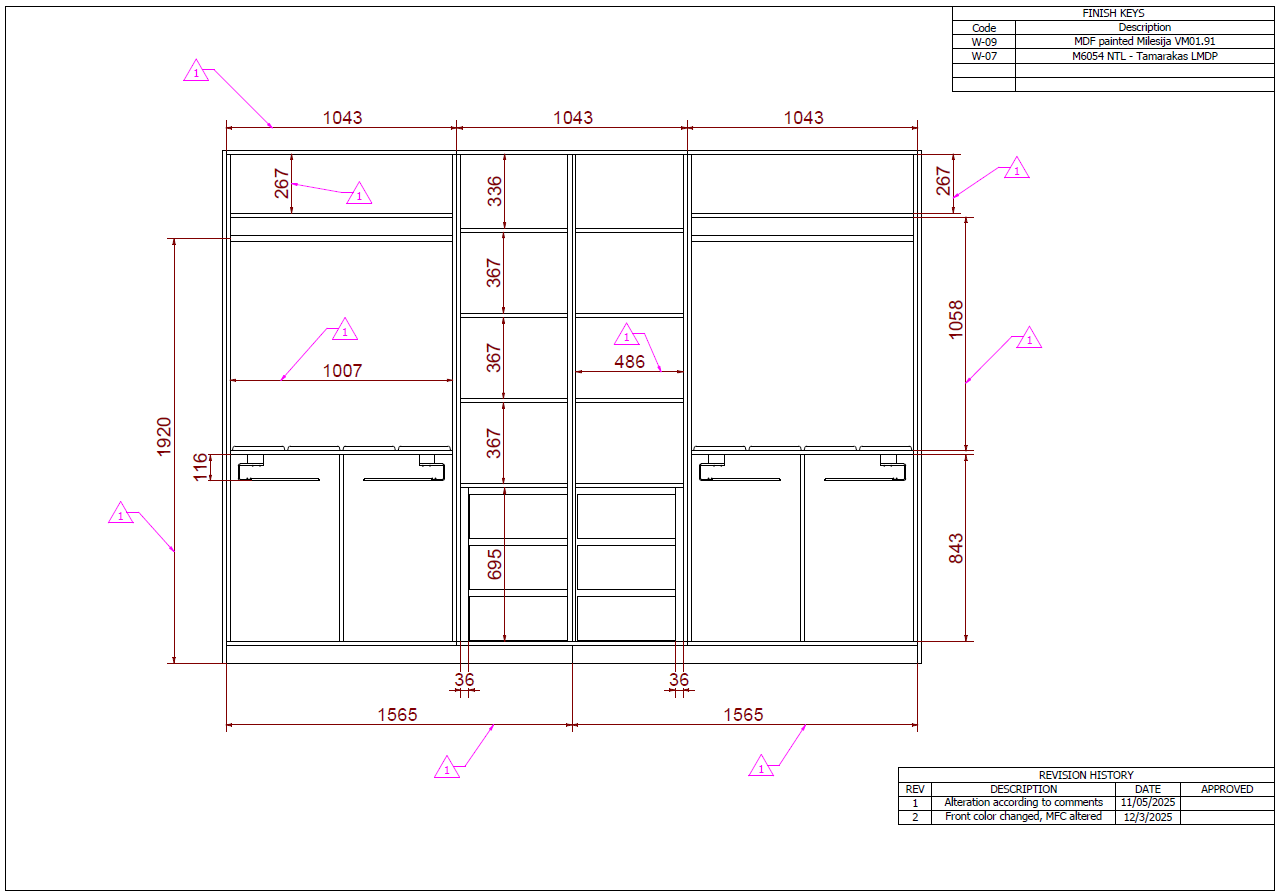
Isometrics with and without doors. A customer approving a wardrobe from a closed-door view has approved a rectangle. The doors-off view is where they see how many shelves they are getting, where the hanging rail sits, and how the space is divided — which is the part they will have opinions about after installation if they have not seen it before.
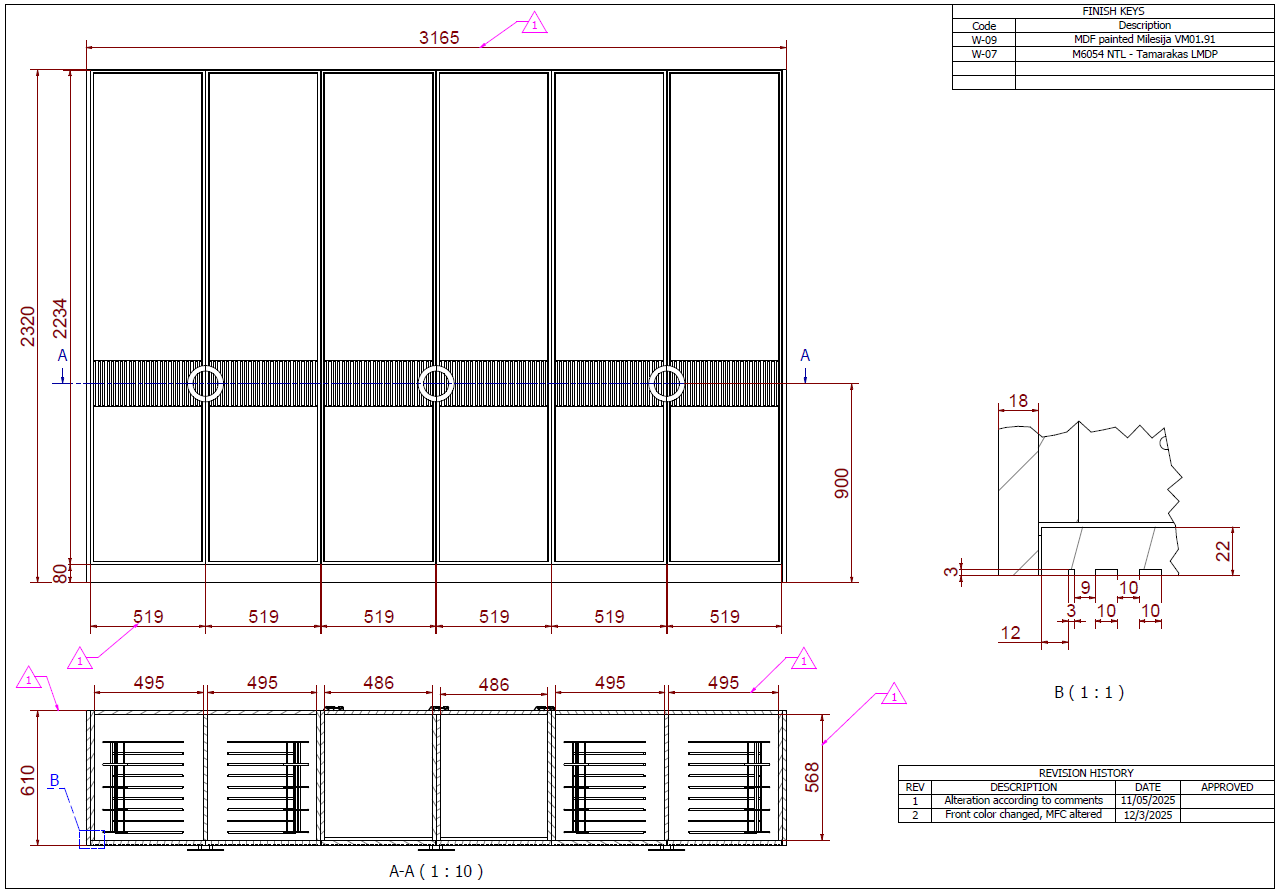
General dimensions, both ways. Overall sizes with the doors on, so it can be checked against the room, and internal dimensions with the doors off, so the customer can check their own things will fit. People measure their hanging space. Give them the number before they measure it themselves and find it short.
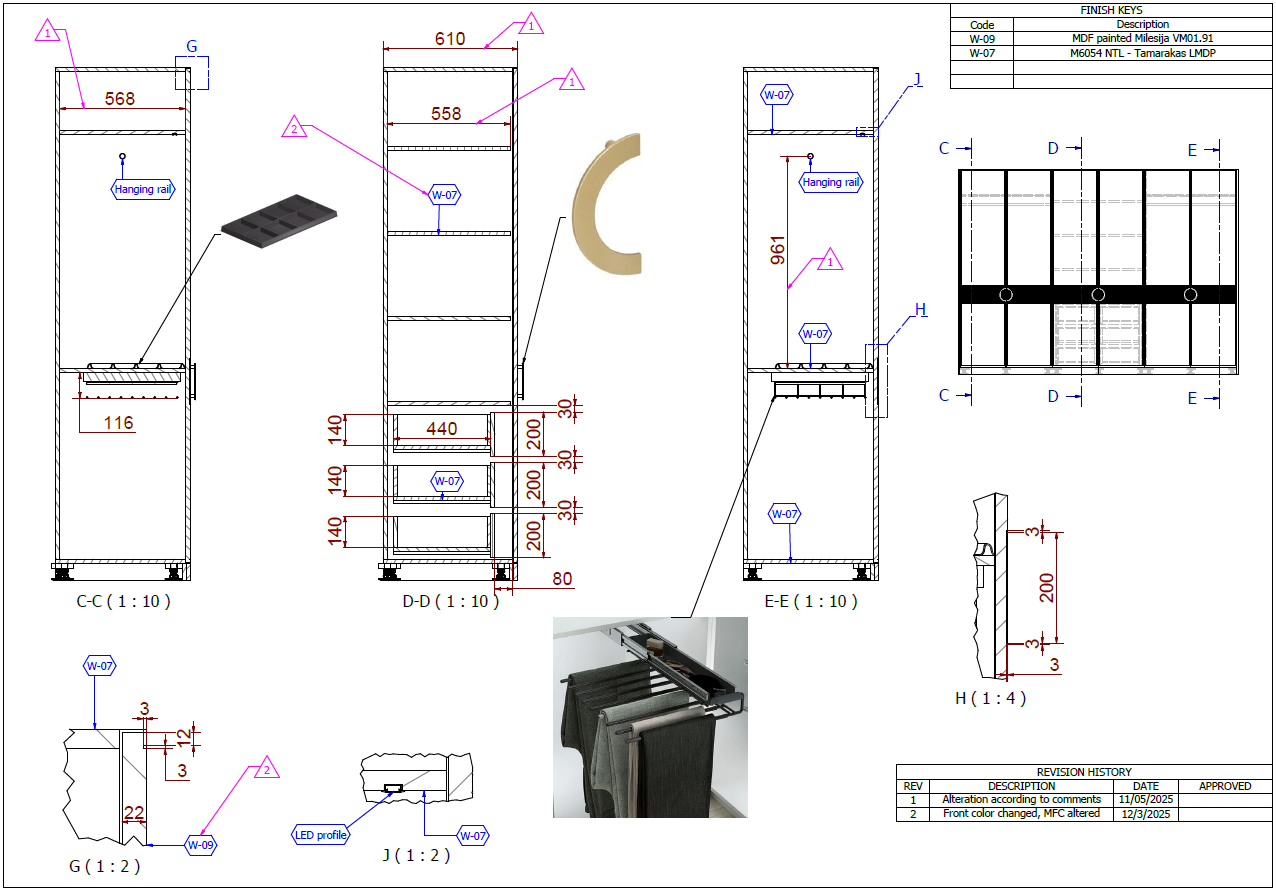
Sections and construction details. Enough to settle how it is actually built — panel thicknesses, how the carcass goes together, how the fronts sit. Not because the customer cares about a cam fitting, but because these are the questions that generate a phone call, and a phone call at approval stage costs a week.
Four sheets is not a small pack because the job was easy. It is four sheets because a confirmation set that runs to twenty does not get read, and an unread drawing has not been approved no matter what the customer signed.
It went to a second revision — which is the point
The customer came back with comments, the drawings were updated, and revision 2 was issued. That is not a failure of the first set. That is precisely what a confirmation set is for.
Changes at this stage cost an hour of drawing time. The same changes after the panels are cut cost material, machine time and a delivery date — and if the customer has already been given a date, they cost goodwill as well. A confirmation round exists to move every change into the cheapest possible part of the process.
The revision is also marked as a revision. Both parties can see what changed between issues, so the approval attaches to a specific, identifiable set of drawings rather than to a vague memory of an email.
Why it was still modelled properly
A four-sheet set for a two-module wardrobe could be drawn in 2D in an afternoon. It was not. It was modelled parametrically in Autodesk Inventor with Woodwork for Inventor, exactly as a full production job would be.
Two reasons. First, the revision. When the customer’s comments came in, the model absorbed them and all four sheets regenerated consistently — no risk of an updated dimension on one sheet and a stale one on another, which is the classic way a 2D confirmation set quietly becomes wrong.
Second, and more valuable: once approved, the same model produced the full production documentation without a single part being redrawn. The confirmation set was not a throwaway sales drawing. It was the first output of the model that would go on to make the cutting list, the part drawings and the machine data.
That is the argument for modelling properly even on a small job, and it is worth understanding if you currently treat approval drawings and production drawings as two separate pieces of work. They should be one piece of work, issued twice.
What the client received
- Isometric views, doors on and doors off
- General dimensions with doors fitted
- General dimensions with doors removed, including internal divisions
- Sections and construction details
- Materials called out — MDF fronts, MFC carcass
- A clearly marked revision 2 following customer comments
When to order a confirmation set
Ask for one when you need a customer’s approval before you can price or order, when the customer is not technical, or when you have been caught before by someone approving a design and then disputing what they approved.
It is the cheapest and fastest thing I produce, and it is often the highest-leverage. Turnaround is usually a couple of days rather than a couple of weeks. If it is approved and you want the production pack, the modelling work is already done — see the kitchen project for what that looks like at module level, or the vanity unit for part level.
Need a set to get sign-off?
Send me the design and tell me who needs to approve it. You will get a price and a timescale within one working day — and for a set like this the timescale is usually days, not weeks.
Other projects
Client name, address and order number are withheld. Every drawing shown is published with permission.